Last login: Tue 29 Sep 2026 on tty1
Archived edition.
$man 1 less
Ten things the page says. Every one of them is on your machine right now — run the command above and check.
-
01
Less is a program similar to more(1), but it has many more features.[man]
-
02
-Pw
changes the message printed while waiting for data (in the.[man]
-
03
--file-size
If --file-size is specified, less will determine the size of the file immediately after opening the file. Normally this is not done, because it can be slow if the input file is large.[man]
-
04
--incsearch
Subsequent search commands will be "incremental"; that is, less will advance to the next line containing the search pattern as each character of the pattern is typed in.[man]
-
05
--line-num-width
Sets the minimum width of the line number field when the -N option is in effect. The default is 7 characters.[man]
-
06
--MOUSE
Like --mouse, except the direction scrolled on mouse wheel movement is reversed.[man]
-
07
--no-keypad
Disables sending the keypad initialization and deinitialization strings to the terminal. This is sometimes useful if the keypad strings make the numeric keypad behave in an undesirable manner.[man]
-
08
--rscroll
This option changes the character used to mark truncated lines. It may begin with a two-character attribute indicator like LESS- BINFMT does. If there is no attribute indicator, standout is used. If set to "-", truncated lines are not marked.[man]
-
09
--save-marks
Save marks in the history file, so marks are retained across different invocations of less.[man]
-
10
--use-backslash
This option changes the interpretations of options which follow this one. After the --use-backslash option, any backslash in an option string is removed and the following character is taken literally. This allows a dollar sign to be included in option strings.[man]
$run --yourself
Page a long file without loading it all
less is the program standing between you and every long output on the system. Ten minutes learning its keys pays back permanently.
$ man less | lessWHAT YOU SHOULD SEEThe page opens. Press space to advance, / to search, n for the next hit, q to quit.
$quiz -n 5
Five questions, each one taking a term out of a line above. Ten points for each. Tap hear it to have a question read to you; answering plays the verdict.
QUESTION 1 OF 5
Which term completes this line from the page? “Less is a program similar to more(1), but it has many more _____.”
From point 1 above.
QUESTION 2 OF 5
Which term completes this line from the page? “If --file-size is specified, less will determine the size of the file _____ after opening the file. Normally this is not done, because it can be slow if the input file is large.”
From point 3 above.
QUESTION 3 OF 5
Which term completes this line from the page? “Sets the minimum width of the line number field when the -N option is in effect. The default is 7 _____.”
From point 5 above.
QUESTION 4 OF 5
Which term completes this line from the page? “Disables sending the keypad _____ and deinitialization strings to the terminal. This is sometimes useful if the keypad strings make the numeric keypad behave in an undesirable manner.”
From point 7 above.
QUESTION 5 OF 5
Which term completes this line from the page? “Save marks in the history file, so marks are retained across different _____ of less.”
From point 9 above.
Answer all five to bank your points.
$play --chapters 5
Five chapters, three voices. Tap one to jump — the player at the bottom of the screen follows.
$tee --everyone
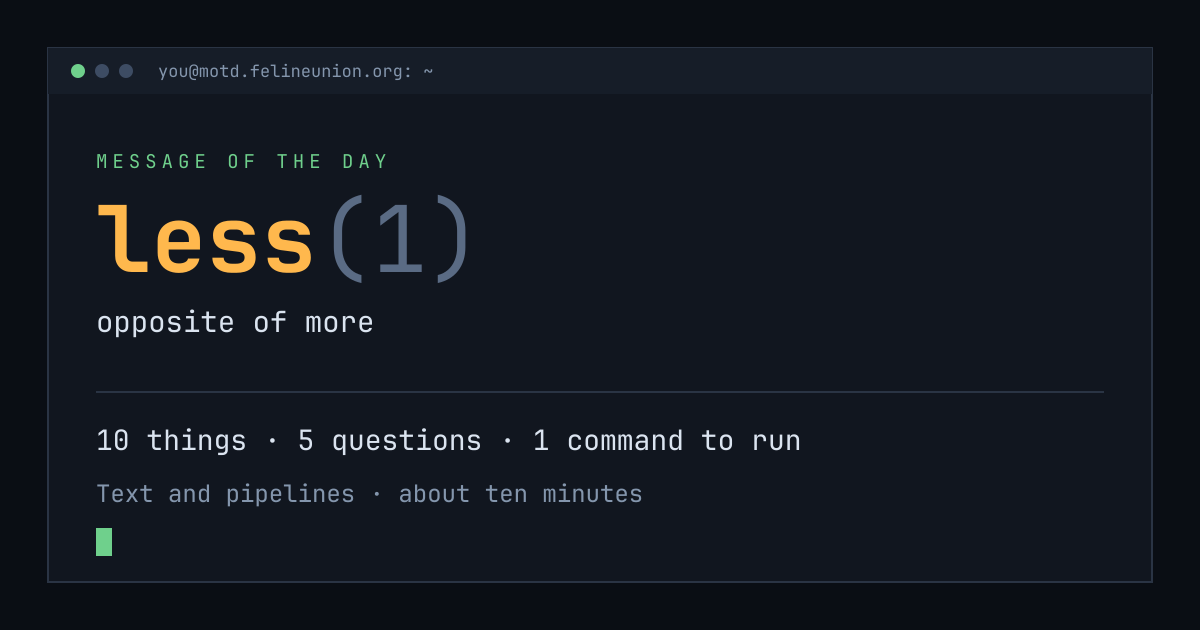
Know someone with ten minutes and a terminal? Send them today's page. This is the card that appears when you post it:
$su - operator
The Operator has a dispatch on less(1),
and he files them for subscribers only. It is free.
Join the club, or read about
the series.
MOTD is a weekday reading of one manual page already installed on your own
machine. Every statement is quoted from that page or from the GNU info
documentation beside it, and every edition names the command that shows you
the source.
archive ·
the operator ·
about ·
podcast ·
Feline Union