Last login: Wed 30 Sep 2026 on tty1
Archived edition.
$man 8 ping
Ten things the page says. Every one of them is on your machine right now — run the command above and check.
-
01
ping uses the ICMP protocol's mandatory ECHO_REQUEST datagram to elicit an ICMP ECHO_RESPONSE from a host or gateway.[man]
-
02
-B
Do not allow ping to change source address of probes. The address is bound to one selected when ping starts.[man]
-
03
-d
Set the SO_DEBUG option on the socket being used. Essentially, this socket option is not used by Linux kernel.[man]
-
04
-D
Print timestamp (unix time + microseconds as in gettimeofday) before each line.[man]
-
05
-H
Force DNS name resolution for the output. Useful for numeric destination, or -f option, which by default do not perform it. Override previously defined -n option.[man]
-
06
-L
Suppress loopback of multicast packets. This flag only applies if the ping destination is a multicast address.[man]
-
07
-n
Numeric output only. No attempt will be made to lookup symbolic names for host addresses (no reverse DNS resolution). This is the default for numeric destination or -f option. Override previously defined -H option.[man]
-
08
-O
Report outstanding ICMP ECHO reply before sending next packet. This is useful together with the timestamp -D to log output to a diagnostic file and search for missing answers.[man]
-
09
-q
Quiet output. Nothing is displayed except the summary lines at startup time and when finished.[man]
-
10
-r
Bypass the normal routing tables and send directly to a host on an attached interface. If the host is not on a directly-attached network, an error is returned. This option can be used to ping a local host through an interface that has no route through it provided the option -I is also used.[man]
$run --yourself
Prove the network path, then bound it
Pinging loopback first separates 'my network is down' from 'my machine is broken'. -c bounds the run so it ends on its own.
$ ping -c 3 127.0.0.1
$ ping -c 3 -W 2 1.1.1.1
WHAT YOU SHOULD SEEThree replies from your own loopback with near-zero time, then three replies from a public resolver with a real round-trip time.
$quiz -n 5
Five questions, each one taking a term out of a line above. Ten points for each. Tap hear it to have a question read to you; answering plays the verdict.
QUESTION 1 OF 5
Which term completes this line from the page? “ping uses the ICMP protocol's mandatory _____ datagram to elicit an ICMP ECHO_RESPONSE from a host or gateway.”
From point 1 above.
QUESTION 2 OF 5
Which term completes this line from the page? “Set the _____ option on the socket being used. Essentially, this socket option is not used by Linux kernel.”
From point 3 above.
QUESTION 3 OF 5
Which term completes this line from the page? “Force DNS name resolution for the output. Useful for numeric _____, or -f option, which by default do not perform it. Override previously defined -n option.”
From point 5 above.
QUESTION 4 OF 5
Which term completes this line from the page? “Numeric output only. No attempt will be made to lookup symbolic names for host addresses (no reverse DNS _____). This is the default for numeric destination or -f option. Override previously defined -H option.”
From point 7 above.
QUESTION 5 OF 5
Which term completes this line from the page? “Quiet output. Nothing is _____ except the summary lines at startup time and when finished.”
From point 9 above.
Answer all five to bank your points.
$play --chapters 5
Five chapters, three voices. Tap one to jump — the player at the bottom of the screen follows.
$tee --everyone
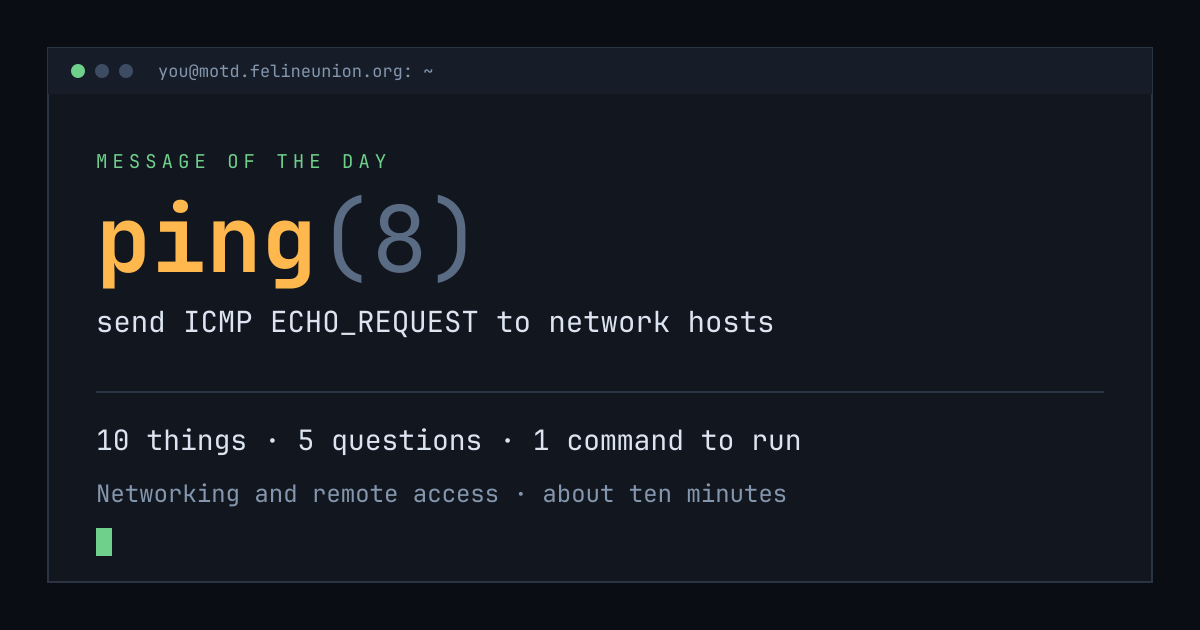
Know someone with ten minutes and a terminal? Send them today's page. This is the card that appears when you post it:
$su - operator
The Operator has a dispatch on ping(8),
and he files them for subscribers only. It is free.
Join the club, or read about
the series.
MOTD is a weekday reading of one manual page already installed on your own
machine. Every statement is quoted from that page or from the GNU info
documentation beside it, and every edition names the command that shows you
the source.
archive ·
the operator ·
about ·
podcast ·
Feline Union