Last login: Wed 28 Oct 2026 on tty1
Archived edition.
$man 1 rm
Ten things the page says. Every one of them is on your machine right now — run the command above and check.
-
01
This manual page documents the GNU version of rm. rm removes each specified file.[man]
-
02
--interactive=always
option is given, rm prompts the user for whether.[man]
-
03
-f, --force
ignore nonexistent files and arguments, never prompt.[man]
-
04
-I
prompt once before removing more than three files, or when removing recursively; less intrusive than -i, while still giving protection against most mistakes.[man]
-
05
--interactive[=WHEN]
prompt according to WHEN: never, once (-I), or always (-i); without WHEN, prompt always.[man]
-
06
--one-file-system
when removing a hierarchy recursively, skip any directory that is on a file system different from that of the corresponding command line argument.[man]
-
07
--preserve-root[=all]
do not remove '/' (default); with 'all', reject any command line argument on a separate device from its parent.[man]
-
08
-r, -R, --recursive
remove directories and their contents recursively.[man]
-
09
-R)
option to remove each listed directory, too, along with all of its.[man]
-
10
If the response is not affirmative, the entire command is aborted.[man]
$run --yourself
Delete carefully, in a directory you own
rm has no undo and no trash. Running it with -v, on a path you typed deliberately, is the habit that saves you.
These commands write files, so run them in a scratch directory:
$ mkdir -p ~/motd-lab && cd ~/motd-lab$ mkdir -p doomed/inner
$ touch doomed/inner/file.txt
$ rm doomed 2>&1 | head -1
$ rm -r -v doomed
$ lsWHAT YOU SHOULD SEEThe first rm refuses, saying it cannot remove a directory. -r removes the tree and -v names each file as it goes.
$quiz -n 5
Five questions, each one taking a term out of a line above. Ten points for each. Tap hear it to have a question read to you; answering plays the verdict.
QUESTION 1 OF 5
Which term completes this line from the page? “This manual page _____ the GNU version of rm. rm removes each specified file.”
From point 1 above.
QUESTION 2 OF 5
Which term completes this line from the page? “ignore _____ files and arguments, never prompt.”
From point 3 above.
QUESTION 3 OF 5
Which term completes this line from the page? “prompt _____ to WHEN: never, once (-I), or always (-i); without WHEN, prompt always.”
From point 5 above.
QUESTION 4 OF 5
Which term completes this line from the page? “do not remove '/' (default); with 'all', reject any command line _____ on a separate device from its parent.”
From point 7 above.
QUESTION 5 OF 5
Which term completes this line from the page? “option to remove each listed _____, too, along with all of its.”
From point 9 above.
Answer all five to bank your points.
$play --chapters 5
Five chapters, three voices. Tap one to jump — the player at the bottom of the screen follows.
$tee --everyone
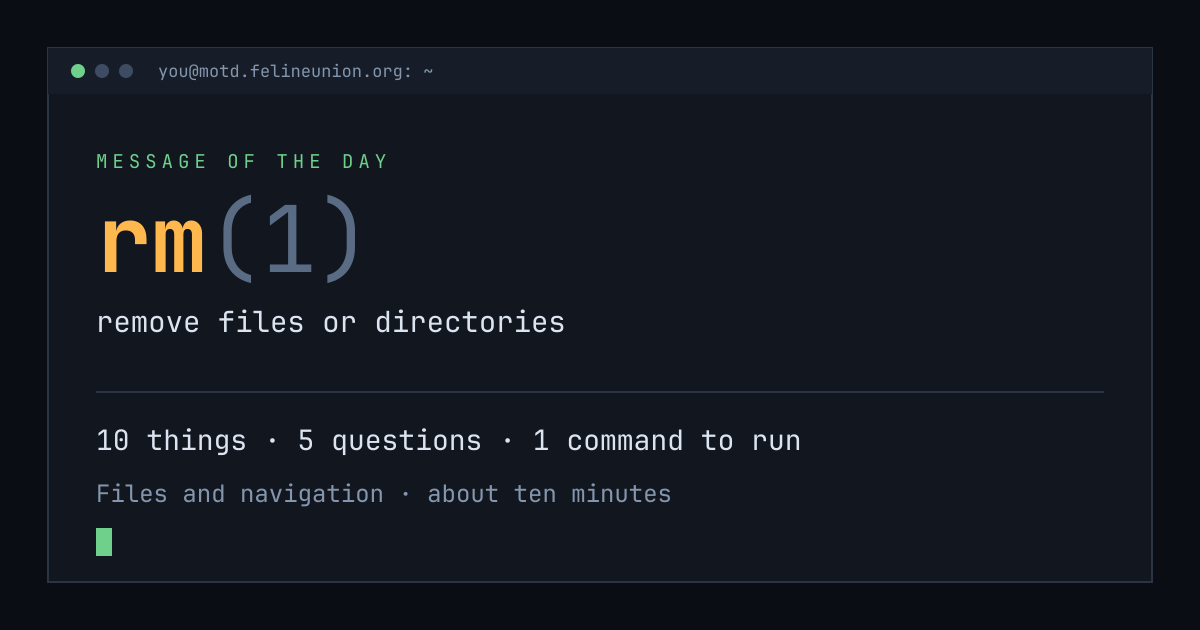
Know someone with ten minutes and a terminal? Send them today's page. This is the card that appears when you post it:
$su - operator
The Operator has a dispatch on rm(1),
and he files them for subscribers only. It is free.
Join the club, or read about
the series.
MOTD is a weekday reading of one manual page already installed on your own
machine. Every statement is quoted from that page or from the GNU info
documentation beside it, and every edition names the command that shows you
the source.
archive ·
the operator ·
about ·
podcast ·
Feline Union