Last login: Mon 02 Nov 2026 on tty1
Archived edition.
$man 1 ssh
Ten things the page says. Every one of them is on your machine right now — run the command above and check.
-
01
ssh (SSH client) is a program for logging into a remote machine and for executing commands on a remote machine.[man]
-
02
-A
Enables forwarding of connections from an authentication agent such as ssh-agent(1). This can also be specified on a per-host basis in a configuration file.[man]
-
03
-a
Disables forwarding of the authentication agent connection.[man]
-
04
-f
Requests ssh to go to background just before command execution. This is useful if ssh is going to ask for passwords or passphrases, but the user wants it in the background. This implies -n. The recommended way to start X11 programs at a remote site is with something like ssh -f host xterm.[man]
-
05
-G
Causes ssh to print its configuration after evaluating Host and Match blocks and exit.[man]
-
06
-g
Allows remote hosts to connect to local forwarded ports. If used on a multiplexed connection, then this option must be specified on the master process.[man]
-
07
-K
Enables GSSAPI-based authentication and forwarding (delegation) of GSSAPI credentials to the server.[man]
-
08
-N
Do not execute a remote command. This is useful for just forwarding ports. Refer to the description of SessionType in ssh_config(5) for details.[man]
-
09
-q
Quiet mode. Causes most warning and diagnostic messages to be suppressed.[man]
-
10
-s
May be used to request invocation of a subsystem on the remote system. Subsystems facilitate the use of SSH as a secure transport for other applications (e.g. sftp(1)). The subsystem is specified as the remote command. Refer to the description of SessionType in ssh_config(5) for details.[man]
$run --yourself
Inspect your SSH setup without connecting anywhere
-G prints the effective config after every match block is applied, which answers 'why is it using that key' without a connection.
$ ssh -V
$ ssh -G localhost | head -12
$ ls -l ~/.ssh 2>/dev/null || echo 'no ~/.ssh yet'
WHAT YOU SHOULD SEEThe client version, then the fully resolved configuration ssh would use for that host, then whatever keys and config you have.
$quiz -n 5
Five questions, each one taking a term out of a line above. Ten points for each. Tap hear it to have a question read to you; answering plays the verdict.
QUESTION 1 OF 5
Which term completes this line from the page? “ssh (SSH client) is a program for logging into a remote machine and for _____ commands on a remote machine.”
From point 1 above.
QUESTION 2 OF 5
Which term completes this line from the page? “Disables _____ of the authentication agent connection.”
From point 3 above.
QUESTION 3 OF 5
Which term completes this line from the page? “Causes ssh to print its _____ after evaluating Host and Match blocks and exit.”
From point 5 above.
QUESTION 4 OF 5
Which term completes this line from the page? “Enables _____-based authentication and forwarding (delegation) of GSSAPI credentials to the server.”
From point 7 above.
QUESTION 5 OF 5
Which term completes this line from the page? “Quiet mode. Causes most warning and _____ messages to be suppressed.”
From point 9 above.
Answer all five to bank your points.
$play --chapters 5
Five chapters, three voices. Tap one to jump — the player at the bottom of the screen follows.
$tee --everyone
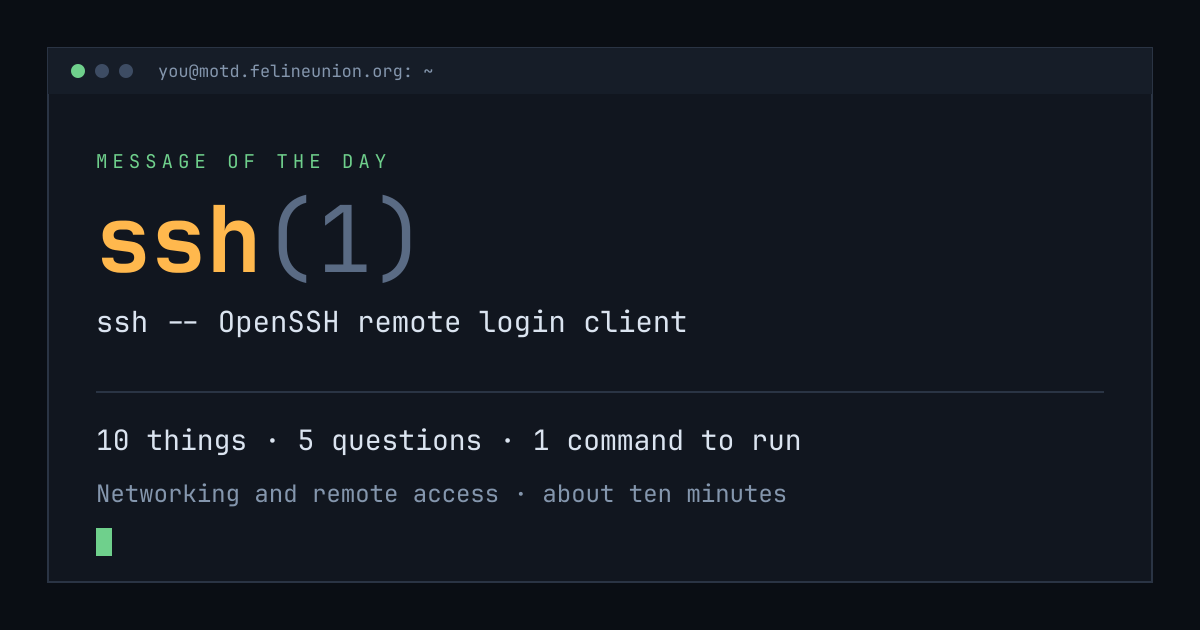
Know someone with ten minutes and a terminal? Send them today's page. This is the card that appears when you post it:
$su - operator
The Operator has a dispatch on ssh(1),
and he files them for subscribers only. It is free.
Join the club, or read about
the series.
MOTD is a weekday reading of one manual page already installed on your own
machine. Every statement is quoted from that page or from the GNU info
documentation beside it, and every edition names the command that shows you
the source.
archive ·
the operator ·
about ·
podcast ·
Feline Union